On 13 September, at half past ten in the morning, @lechacon rolled down a start ramp in Germany for the eleventh running of a flat time trial along the Vilstal. Twenty-five minutes and forty-four seconds later the clock stopped, and he had held 233 watts with his heart rate averaging 177 and topping out at 182.
He had started using IntervalCoach exactly three months earlier, on 13 June.
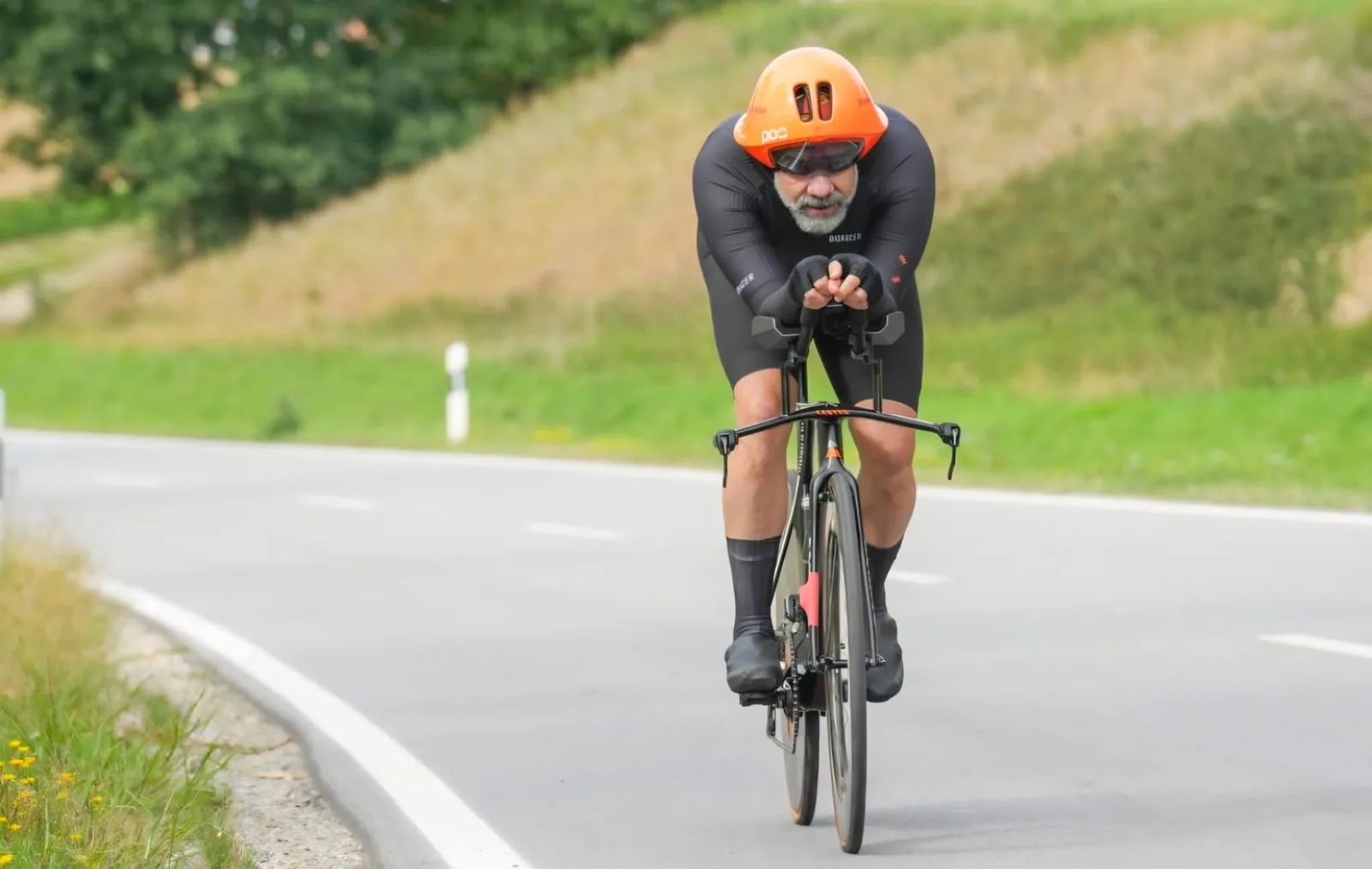
@lechacon is 53. He trains four or five times a week, almost always a little over an hour, always at five in the afternoon, and his Fitness (CTL) never went above 57 all season. It read 46 on race morning. Most of the riders in this series are built on volume. He has less of it than any of them, and he went just as deep.
He is also the most completely coached athlete we have featured: every one of the 72 sessions on his calendar across those three months was generated by IntervalCoach, and he rode 50 of them. The instruction he wrote into his account when he set it up is still there, in Spanish, and it is refreshingly specific. He focuses on time trials of 17 to 22 kilometres, flat and rolling, and he wants the weight and the power to ride them at 40 to 43 km/h.
He did not arrive here first, or cheaply:
"I came to Intervals.icu and IntervalCoach after trying everything: from a personal trainer, far too expensive for me to afford, to just Garmin, and other AI like Enduco." ("A intervals.icu y intervalsCoach llego después de probar tanto con entrenador personal (muy caro para poder pagarlo) hasta el uso normal de Garmin y otras IA como Enduco.")
What happened next is the part I would have wanted to read before writing any of this. He put the target in and asked whether it was reachable:
"I started by making my goal clear, and asking whether I would hit around 280 to 300 watts and 40 to 43 km/h on race day. The answer was plain: there is little time, but anything is possible, better to focus on 240-250 watts." ("Comencé dejando claro mi objetivo y si llegaría a mover cerca de 280w a 300w y 40 a 43km/h el día de carrera, la respuesta fue clara… hay poco tiempo pero todo se puede, mejor concentrarse en 240-250w.")
Hold that number against what follows. Three months later he raced at 237 watts normalised.
The rehearsal
Three weeks out, on 20 August, his plan gave him a session called "Ataque y Contrarreloj": eighty-five minutes with a 22-minute solo time trial block at 95 to 100 percent of threshold and a one-minute sprint finish on the end. The race, three quarters length, at the intensity the day would ask for. His workouts come to him in Spanish, which is the small detail I like most about his file. The coach opened that morning with "¡Hola Lechacon! ¡Hoy es día de breakaway!" and sent him out to prepare a German time trial in the language he thinks in.
From there the run into the race is about as clean as a taper gets: 399 planned TSS, then 307, then 258, then 137. Fatigue (ATL) fell from 85 to 34 while Fitness slipped only from 57 to 46, which is the whole point of a taper and harder to execute than it looks. He did not execute all of it. The peak week prescribed 399 TSS and he rode 210, leaving behind the hardest session of the block and a ramp test. Three ramp tests were scheduled across the three months. He did two, and skipped the one closest to the race.
The number that went down
That skipped test shows up in the one metric that measures capability rather than work done. In late June the model held his threshold at roughly 248 watts. By 12 September, the day before the start ramp, it had stepped down to about 238.
There is no mystery in it. An estimate of threshold is only as fresh as the hardest effort you have recently given it, and a rider who is tapering, and who skipped his last ramp test, stops feeding it. The number drifts down because the evidence for the higher one is ageing, not because the rider is.
Which is what makes the race worth reporting. His normalized power over those twenty-six minutes was 237 watts. The estimate, set the day before by a model he had not given a maximal effort in weeks, was 238.
What the score noticed
| Week | Total | Overload |
|---|---|---|
| Jun 21 | 47 | 26 |
| Jul 12 | 63 | 69 |
| Sep 6 | 71 | 100 |
| Sep 13 | 61 | 29 |
Overload reached 100 twice in the build and then fell to 29 in race week, which is a taper showing up as a number. The column that climbed quietly underneath it was Consistency, from 26 in late June to 100 on race day. He turned up.
The day itself
The file shows a time trial. It does not show that the day started at four in the morning, with an hour's drive to meet his club and two more hours to the start.
Nor does it show how much of the day was planned rather than improvised:
"The system did the whole plan for me, minute by minute: what to do, what to drink and how much." ("el sistema me hizo toda la planificación minuto a minuto, que hacer, que tomar y cuanto.")
He finished tenth of fifteen. The official sheet puts the course at 17.5 kilometres and his average at 40.8 km/h: inside the 40 to 43 he had written into his account three months earlier, on watts the coach had talked him down to. His own computer recorded 17.0 kilometres and 25:51 of moving time, which is what GPS does with a flat course and a clock that starts a few seconds late.
A year earlier he rode the same event in 26:15. This time, 25:44. Thirty-one seconds.
He was not saving anything either. An intensity factor of 0.975 held for twenty-six minutes at 177 beats per minute is a rider who emptied the tank, and he rated it an eight out of ten afterwards.
What is next
He was back on the bike within three days. VO2max work has returned to his calendar and his strength sessions have switched from base-phase form work to build-phase loading. There is no new race on his calendar yet. For a rider whose season just ended on a start ramp, the plan already reads like someone thinking about the next one.
You can follow him at intervalcoach.app/p/lechacon. You can see your own version of all of this on your Analytics page: your eFTP history, your consistency, the shape of your own build. And if you would like to be featured in a future spotlight, reply to any IntervalCoach email and say so. The riders in this series are real, the numbers are theirs, and the work is the point.