Most training plans know what phase you are in. Far fewer know what you can currently hold at threshold, whether the session they just picked sits above or below that, and whether you have been finishing the ones like it.
IntervalCoach now scores each of your five energy systems from your own best efforts, scores every session in its catalog the same way, and matches one to the other. The session you get on a threshold day is chosen against a number that describes you at threshold.
The Athlete Profile, in one paragraph
Five systems: endurance, tempo, threshold, VO2max, anaerobic. Each scored 0 to 10 by comparing your best effort in the last six weeks with your best ever at the duration that system is read from. A 7 at threshold means you are currently near your own ceiling there. A 4 means there is a gap between what you have done lately and what you have shown you can do. It says nothing about other athletes, which is the point: the comparison that matters for picking tomorrow's session is with yourself.
Both halves had to be measurements
The idea only works if both sides of the match are measured rather than labelled, and neither was.
On the athlete side, the profile was a measurement only if you rode with a power meter. For everyone else it fell back to counting minutes, so a runner's "threshold 6.5" described how much threshold work they had done rather than how well they had done it. Two athletes who trained the same amount scored the same, however differently the sessions had gone. A number like that cannot tell you what to prescribe. Running is now scored against the athlete's pace curve and swimming against swim pace, and where nothing can be measured the card says "training volume, not a measured best" instead of showing a score that means something else.
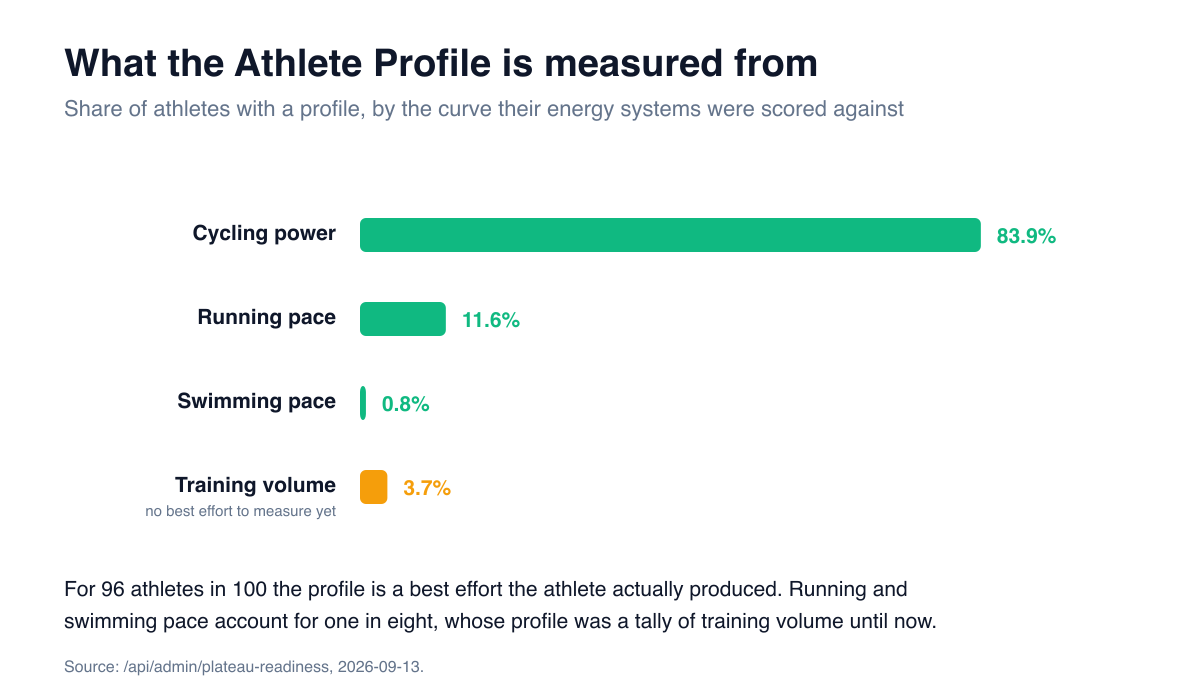
For 96 athletes in 100 the profile is now a best effort they actually produced. Running and swimming pace account for one in eight of those, and they are the ones this changed most.
On the catalog side, every session needed a difficulty, and it had to be computed rather than assigned. A hand-written number drifts: someone types a 7 for a session, the session's rep length changes two releases later, and the 7 stays. So each session is scored from what it actually asks for, per system it trains: the working intensity, how long the reps are, how much rest sits between them, and the load it carries. A session that trains two systems carries a separate score for each, because a hard threshold session is not automatically a hard endurance session.
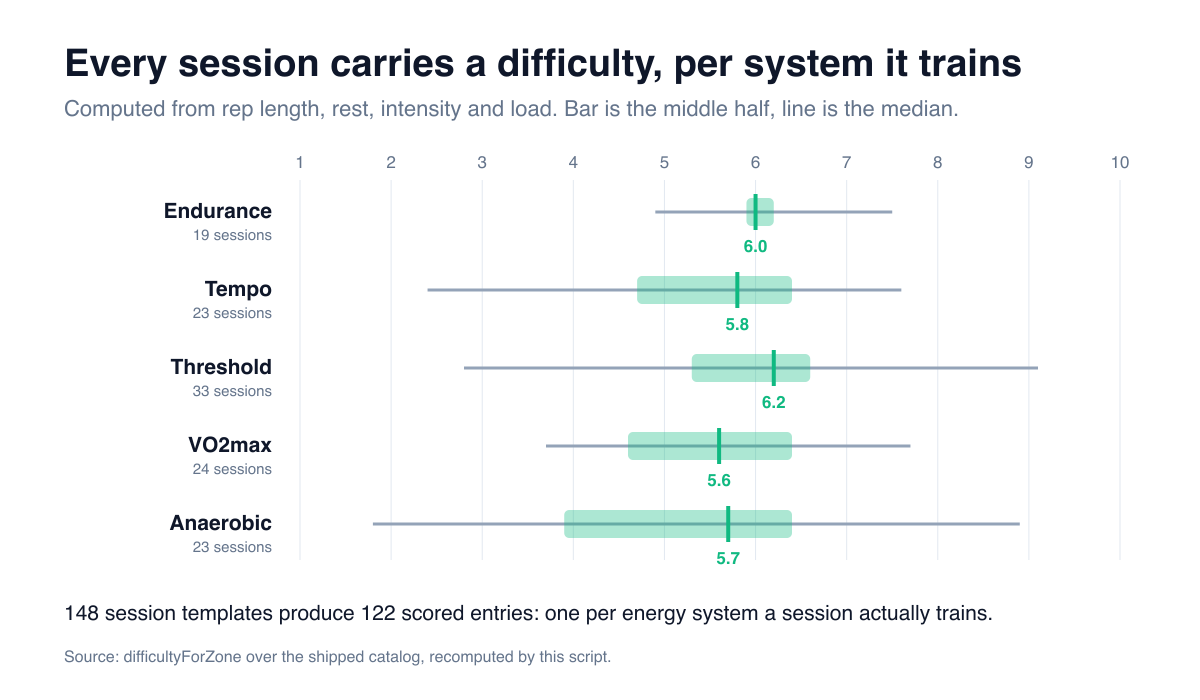
The spread is what makes matching possible. The quality systems run from about 2 to about 9 with medians clustered near 6, so there is something to pick at most levels. Endurance is the exception, packed between about 5 and 7.5, which matters in a moment.
How the target is set
Not from your score. From what you have been finishing.
For each system, IntervalCoach looks at the sessions you completed in the last six weeks, takes a point near the top of that range, and adds a small step up. It needs at least five completed sessions before it will set a target at all. At three sessions the top of your range is simply your hardest session, and one unusually good day would become the standard you are held to next week.
Your measured level then nudges that target by a capped amount. A system scored from training volume never nudges it, because that number describes how much you trained rather than how well.
The band is deliberately lopsided
Around that target, sessions are kept inside a range that reaches 1.8 points below and 0.7 points above. The room to go easier is more than twice the room to go harder.
That asymmetry is the whole safety argument. Being handed something well inside your range costs you one session of stimulus. Being handed something well above it costs you the session and often the next two days.
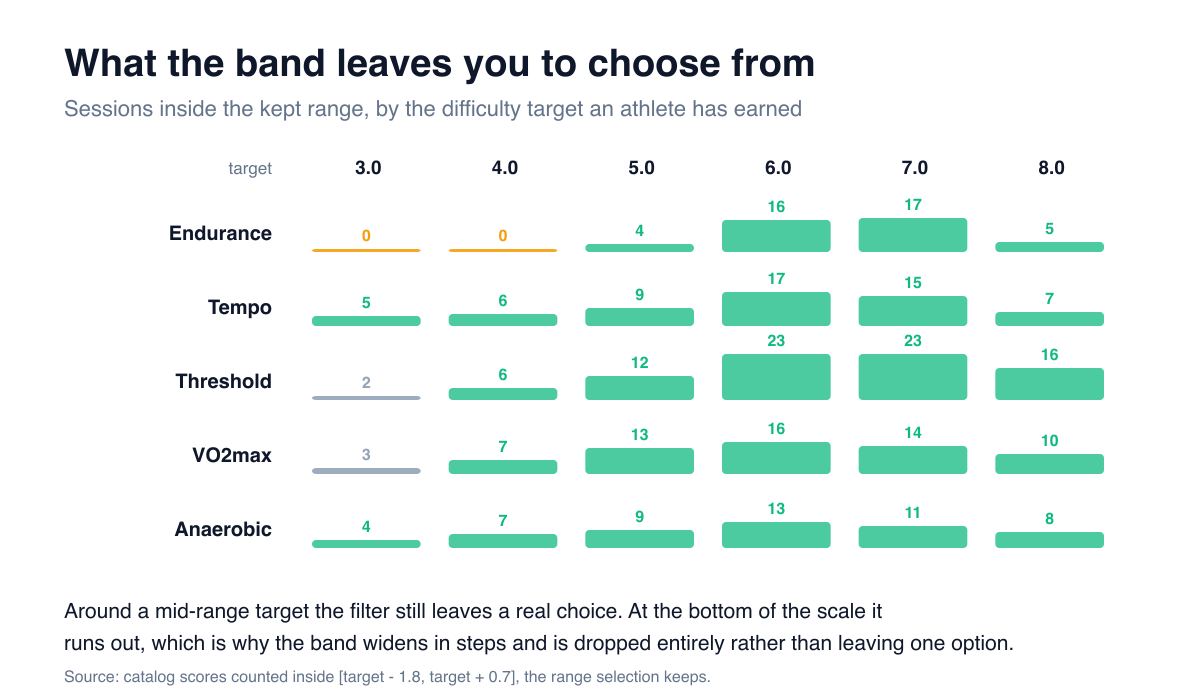
The chart also shows where this runs out. Around a mid-range target each system leaves a real choice. At the bottom of the scale it thins fast, and endurance has nothing at all to offer at a target of 3 or 4, because easy sessions do not get much easier than easy. That is a property of the catalog, and it decides the design: the band widens in steps, and if too few sessions still survive it is dropped entirely. A filter that leaves one candidate is worse than no filter, because you would get the same session every week.
What the same measurements refuse
A number good enough to pitch a session is also good enough to say "not this one".
When your power profile shows a clear weak point, the coach now offers to train it rather than only naming it. One question, once: make this a focus for the block? Saying no, or ignoring it, changes nothing.
And when the measurements say the problem is not today's session but the last month, there is now a mode for that. If your power has been falling for four weeks while you kept training, and your resting heart rate or HRV is still off your own baseline, IntervalCoach can hold load at 60% and keep everything easy until that turns. It will not do this to someone who simply trained less, or whose numbers are already climbing back. It is off by default and you switch it on yourself under Settings, Beta.
What this does not claim
It does not claim to make you faster. The honest position is that we can measure how sessions are chosen, and we cannot yet measure what that choice produces. The loop that would answer it, your session's own result moving your score, is built but not connected, and the weekly history it needs to be tested against started this month. When there is enough of it, that will be its own post, with the result whichever way it falls.
It also does not claim the match is always available. About four athletes in a hundred have no measured system yet, and endurance is the one most often missing, for roughly one in ten. At the bottom of the difficulty scale the catalog thins to the point where the band has to be abandoned. Both limits are in the charts above rather than smoothed out of them.
What comes next
Three things, in order. Connecting the session's result back to the score, so a cleanly executed threshold session moves your threshold number instead of waiting for your power curve to catch up. Showing you that movement, attached to the session that caused it. And noticing when a score has sat flat for a month despite you training that system, which needs four consecutive weeks of history and is the reason we started recording it.