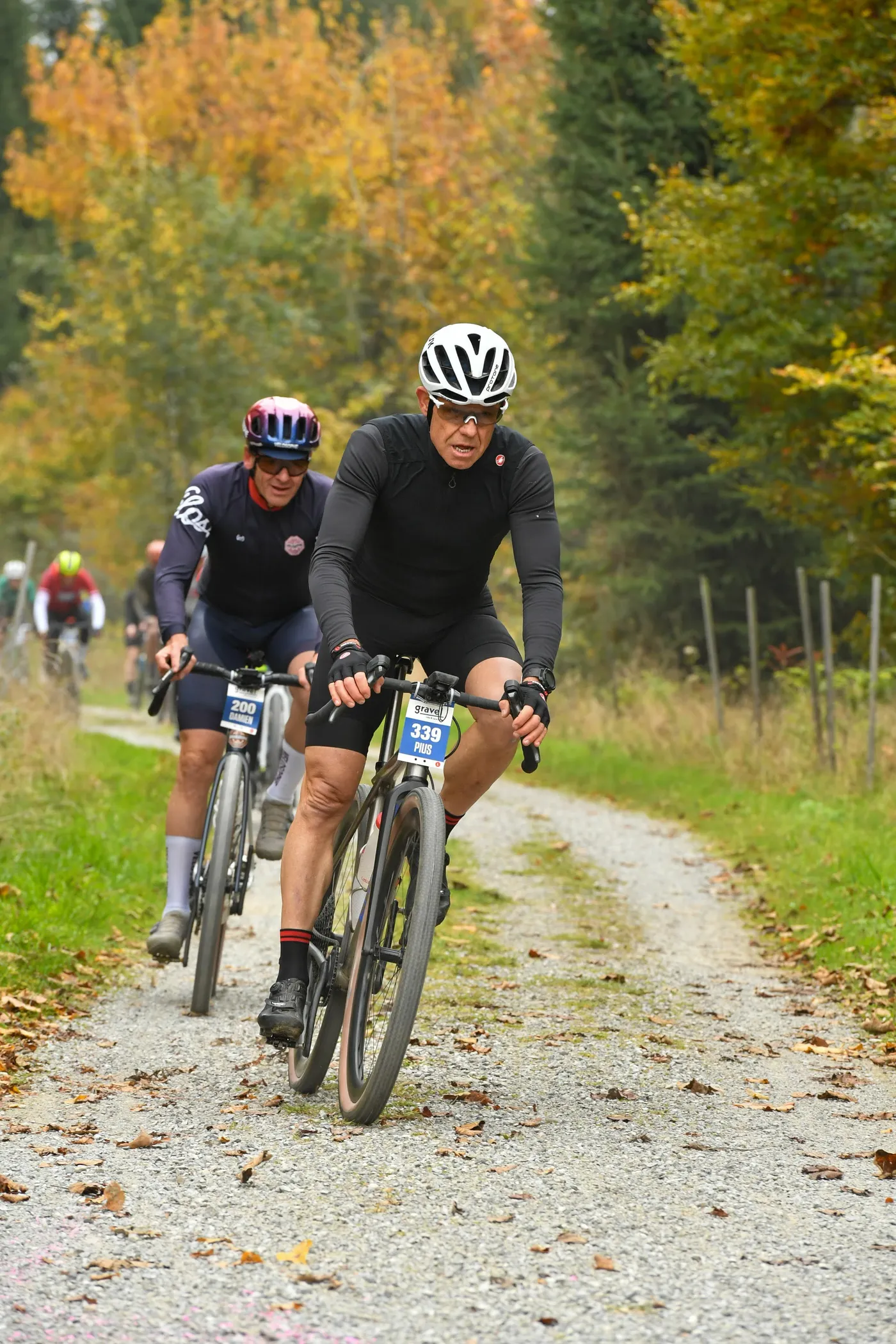
On the ninth of May, Pius rode 304 kilometres. Not across a weekend: across a single day. Twenty hours and twenty minutes over the gravel of central Switzerland, one ride worth 1,081 TSS. For scale, that is more than nine times the training load of anything else in his block. His fitness (CTL) jumped from 69 to 91 overnight, and his fatigue spiked to a number most riders never see.
Here is the part that stayed with me. Most weeks, Pius trains for about an hour at a time, indoors, on a trainer.
That contrast is the whole reason I wanted to feature him. There is a version of endurance training that is all epic outdoor volume, and it photographs well, but it is not how most people with jobs and Swiss winters actually get fit. Pius, a Masters gravel racer with more than forty years of endurance sport behind him, does something more interesting and more repeatable: he keeps a small, sharp, consistent structured base, and then he cashes it out on enormous days.
The engine, built indoors
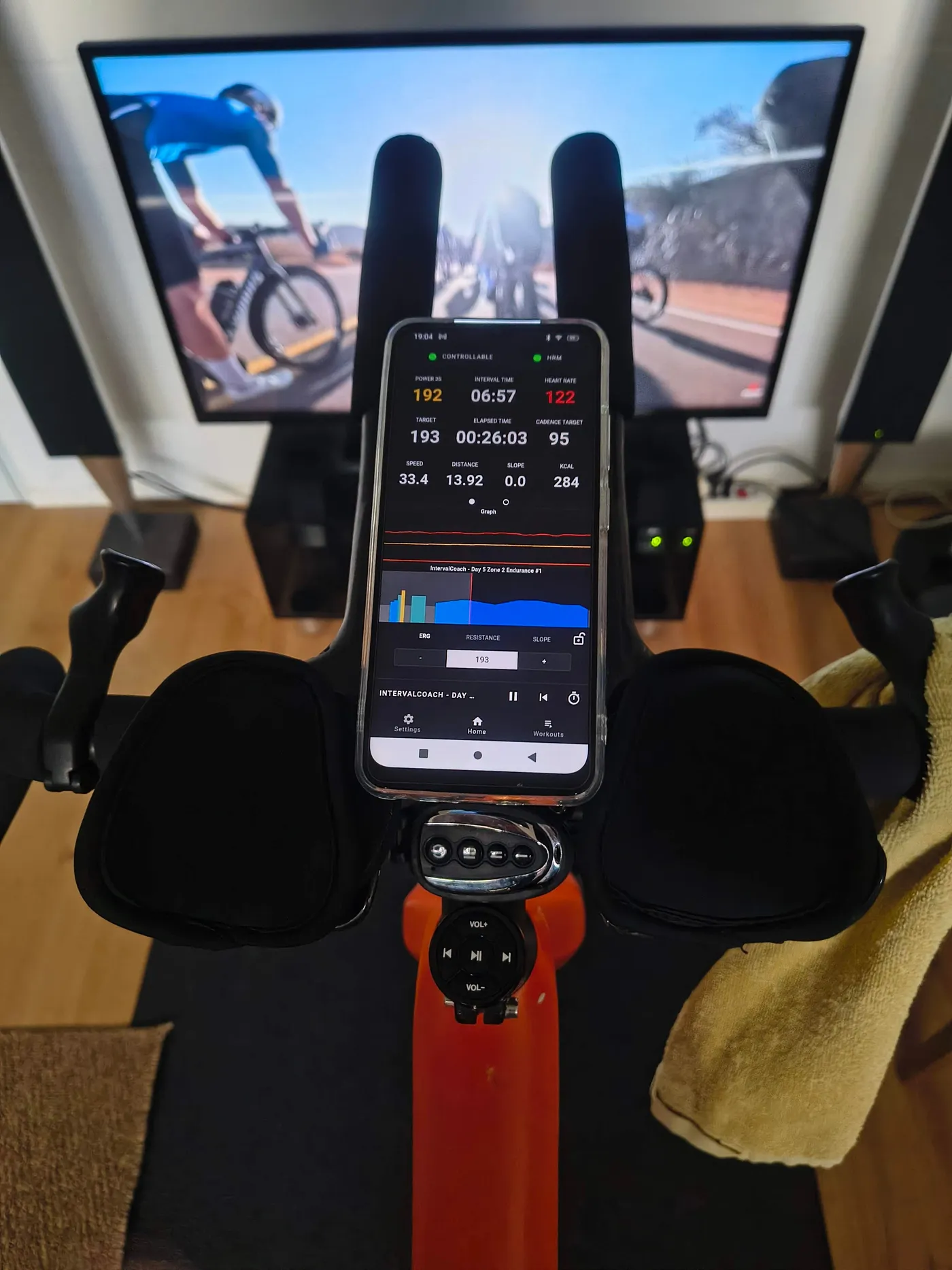
Look at a normal week and it is modest. Monday through Thursday, roughly sixty minutes at a time on the trainer: a Sweet Spot workout, a set of VO2max intervals, a threshold block his plan calls "Schwellenintervalle" because IntervalCoach coaches him in German. Friday off. The weekend is where the long outdoor rides live. None of the indoor work is heroic on its own. All of it stacks.
He is deliberate about why it is built that way. In his own words:
One hour on the trainer gives me roughly the same active pedalling time as 75 to 90 minutes on the road. Spinning at 80 to 100 RPM protects my joints while squeezing every drop of value out of my base training.
You can see that discipline in the files. His Zone 2 sessions come back at 98 to 100 rpm with almost no cardiac drift, which is a rider executing an easy ride properly rather than letting it creep.
The watts tell the story cleanly. Across the winter and into spring his eFTP climbed from 267 to 298, a gain of 31 watts, and his 20-minute power went from 252 to 293. That is a real engine, built an hour at a time in a room. It has eased slightly to 285 now, which is exactly what you expect from a rider deep in a gravel-specific volume block rather than chasing a peak number on the trainer.
What I like about his setup is that IntervalCoach is not fighting him for control. Some of his indoor sessions still come from his own imported TrainerDay plan, and rather than overwriting them, the coach adapts those workouts in place before he rides them in Auuki. It meets the athlete where he already is.
The number he started trusting this year
The other change this season was not a training change. It was a measurement one. Pius put it better than I could:
For over 40 years of endurance sports, I relied on my gut feeling when it came to recovery and training planning. But when you want to squeeze out every bit of your potential, intuition alone eventually isn't enough.
He is a Joe Friel reader, so the framework is familiar: real gains come from supercompensation, the balance between a hard enough stimulus and enough recovery to absorb it, and the markers that tell you where you are sit in the autonomic nervous system. Resting heart rate. HRV stability. For 2026 he added a wearable that reports those every morning, and his daily plan now waits for that sync before it decides anything.
The app takes over the precise interpretation of these complex ANS metrics, objectively assesses my current recovery state, and dynamically adjusts my workouts. For me, this is the absolute game-changer of the season: I can push hard key sessions precisely when my body is ready for them.
That is the part I would underline for anyone reading. The value is not the number on the wrist. It is that the hard session lands on the day the body can take it, and gets moved on the day it cannot.
What the score noticed
His Training Score reads like a rider who races and recovers rather than one chasing a straight line up. The total eased through the block, but the number that matters here, Fitness Base, barely moved.
| Week | Total | Fitness Base |
|---|---|---|
| May 3 | 78 | 82 |
| May 31 | 68 | 84 |
| Jun 28 | 62 | 80 |
| Jul 26 | 64 | 79 |
The engine stayed built. The total simply tracks the rhythm of a season spent hitting big days and absorbing them, which is what the score is supposed to reflect. He trains on a Polarized model: mostly easy, occasionally very hard, very little in between. For a rider whose events are measured in hundreds of kilometres, that is the right shape.
The day ahead
The May ultra was not a one-off. Six weeks later he rode Octopus Gravel, 155 kilometres more. And the reason his indoor weeks have quietly ticked back up in July is that another one is coming: Roesti Gravel on the twentieth of August, three weeks out. The plan has two big outdoor long rides stacked into early August, 300 and 200 TSS, the final real volume before he lets the fatigue drain and lines up.
If you want to see what a small, honest, indoor base can do when you point it at a huge day, watch how his numbers settle in the week after Roesti. That is the snapshot I will be looking for.
When he read this piece, Pius sent one more thought: that it should be useful to riders his age, who get handed plenty of reasons to take it a little easier. He offered a line from Friel as the answer to them.
You aren't old until age becomes your excuse. If you continue to remind yourself of your age and use it as a crutch, no matter what that number is, you'll come to believe that high achievement is impossible.
You can see your own version of this on your Analytics page: your power curve, your eFTP history, the shape of your own build. And if you would like to be featured in a future spotlight, reply to any IntervalCoach email and say so. The riders in this series are real, the numbers are theirs, and the work is the point.