Periodization is how you organize training stress over time. The model you choose determines how hard your weeks get, when you recover, and how your intensity is distributed across easy, moderate, and hard sessions. There is no single best model. The right one depends on your experience, your schedule, and your goals.
IntervalCoach supports five periodization models, each backed by sports science research. Here is how they work and who they suit.
Linear: the steady climb
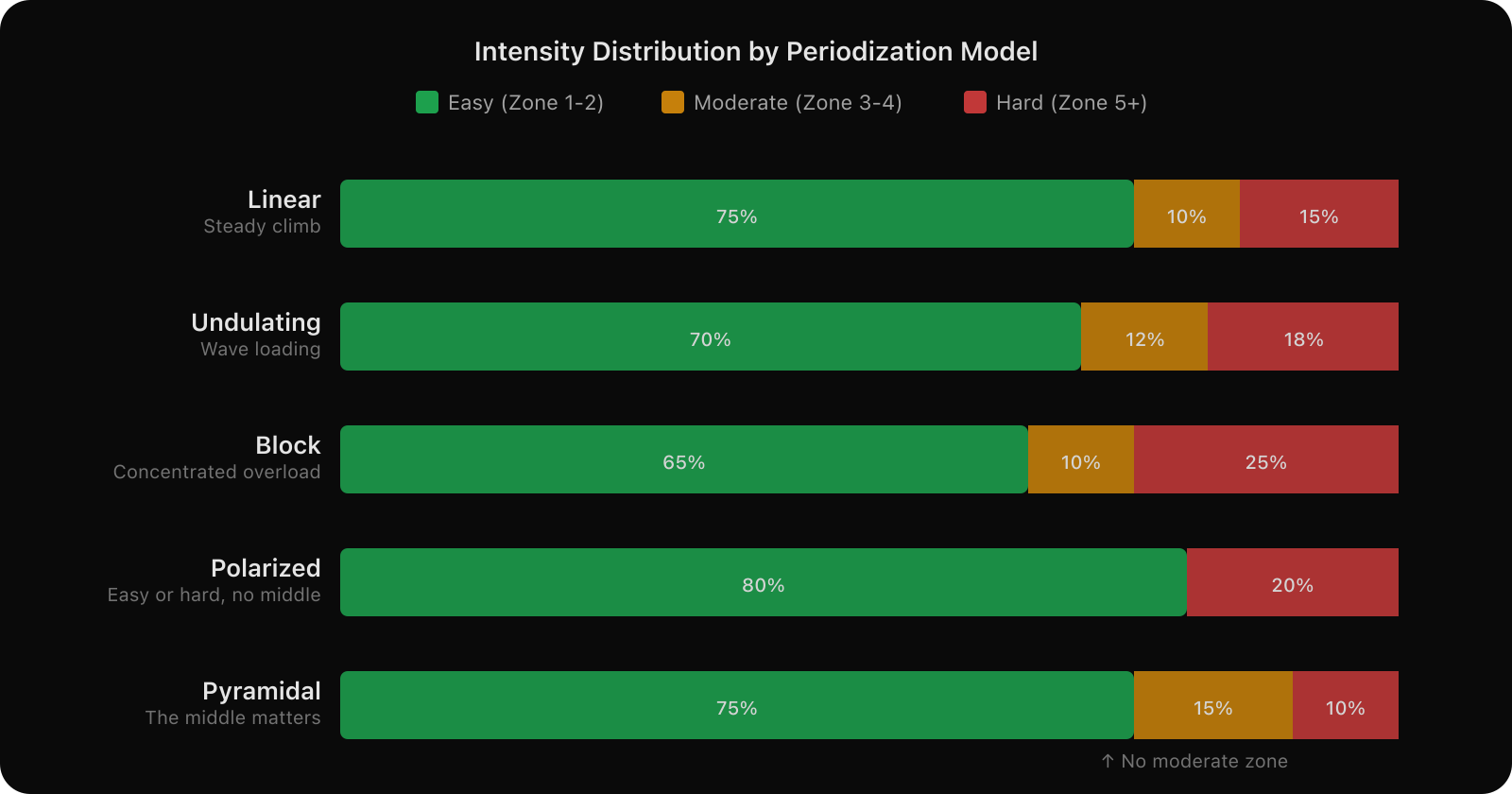
Linear periodization is the classic approach from Bompa and Matveyev. You increase training load by 3-5% each week for three weeks, then take a recovery week. Rinse and repeat. The intensity distribution is about 75% easy, 10% moderate, 15% hard.
This model works well if you are building fitness from scratch or returning after a break. The predictable structure makes it easy to follow, and the gradual ramp gives your body time to adapt. The downside is that experienced athletes can hit a plateau because the stimulus stays fairly uniform week to week.
Undulating: wave loading
Undulating periodization varies the emphasis week to week. One week might focus on aerobic volume, the next on threshold development, the next on VO2max work. The distribution lands around 70% easy, 12% moderate, 18% hard, but it shifts across the cycle.
This model suits intermediate athletes who get bored with routine or who respond well to variety. The constant variation prevents staleness and can break through plateaus. The trade-off is that it requires more self-awareness about fatigue since week-to-week comparisons are less meaningful.
Block: concentrated overload
Block periodization, based on Issurin's research, packs three weeks of focused training on a specific energy system (threshold, VO2max, etc.) followed by a deep recovery week. The distribution is roughly 65% easy, 10% moderate, 25% hard during loading weeks.
This is an advanced model for experienced athletes with strong recovery capacity. It works especially well when you have a short preparation window before a goal event, because the concentrated stimulus drives fast adaptation. But the loading weeks are genuinely hard, and the recovery weeks must be respected. Not suitable for beginners.
Polarized: go easy or go hard
Polarized training, from Stephen Seiler's research on elite endurance athletes, splits your time into 80% low intensity and 20% high intensity with almost nothing in the middle. Zone 3, tempo, sweet spot? Off limits.
The logic is straightforward. Easy work builds your aerobic engine without accumulating much fatigue. Hard work pushes your ceiling higher. Moderate work sits in an awkward spot: hard enough to tire you out, but not hard enough to produce the same adaptations as true high-intensity efforts.
This model works well for well-trained endurance athletes, especially those prone to overtraining or who struggle to keep easy days easy. If every "recovery ride" turns into a tempo effort, polarized forces discipline. It is also great for time-crunched athletes who cannot afford to spend recovery capital on moderate work.
Pyramidal: the middle matters
Pyramidal training, supported by Esteve-Lanao's research, distributes intensity like a pyramid: 75% easy, 15% moderate (tempo and sweet spot), 10% hard. Unlike polarized, it deliberately includes moderate work as a productive training stimulus.
For cyclists, this is where sweet spot lives: those 20-minute efforts at 88-93% of FTP that feel challenging but manageable. For runners, it is tempo runs and threshold work. These sessions build lactate clearance and muscular endurance in ways that easy and hard sessions alone may not.
Pyramidal works well for athletes who respond to sustained moderate efforts. If your FTP climbs from sweet spot work and you recover fine, cutting it out entirely would leave gains on the table. It also suits athletes with more training time (10-15 hours per week) who have the recovery capacity to absorb the extra stimulus.
How to pick the right model
Here are some practical guidelines:
- New to structured training? Start with Linear. The predictable ramp is forgiving and teaches you how your body responds to progressive overload.
- Hit a plateau? Try Undulating or switch between Polarized and Pyramidal. The change in stimulus can break through stagnation.
- Short time to race day? Block periodization drives fast adaptation when you only have 6-8 weeks.
- Always tired on hard days? Move toward Polarized. Too much moderate work is probably eating into your recovery.
- FTP stalled on a polarized plan? Add some sweet spot through Pyramidal. The specific threshold stimulus can restart progress.
Switching models through the season
Most athletes benefit from using different models at different points. A base phase might use Linear or Pyramidal to build aerobic capacity and threshold. A build phase might shift to Block for concentrated high-intensity work. A peak phase could go Polarized to sharpen fitness while keeping fatigue low.
In IntervalCoach, you can switch between all five models in your settings, and the system adjusts your weekly intensity distribution, TSS targets, and recovery weeks accordingly.
How IntervalCoach tracks your actual distribution
Choosing a model is one thing. Following it is another. Most athletes think they are training polarized but their data tells a different story: too much time in zone 3, not enough truly easy rides, or hard days that are not hard enough.
The analytics page tracks your actual Training Intensity Distribution (TID) over the past 30, 90, and 365 days. It breaks down how much time you spent in each zone and compares it to the target distribution for your chosen model. If you selected Polarized but 25% of your training is in the moderate zone, the chart makes that visible immediately.
This is not just a report card. It is a diagnostic tool. If your distribution drifts toward pyramidal when you intended polarized, that is useful information. Maybe your easy rides are not easy enough. Maybe your threshold intervals are landing in zone 3 instead of zone 4. Or maybe your body naturally gravitates toward a pyramidal pattern, and you should consider switching models to match what you are actually doing.
If you are not sure which model fits you best, look at your TID chart for the past 90 days. The distribution you naturally fall into, before any deliberate planning, is often a good starting point. From there you can decide whether to lean into it or deliberately shift toward a different model.
The foundation all models share: zone 2 quality
Regardless of which model you choose, the quality of your easy training matters more than most athletes realize. Every model dedicates at least 65-80% of training time to low intensity. If that time is not productive, no amount of interval work will compensate.
Zone 2 training is not just "riding easy." It is a specific physiological stimulus that builds mitochondrial density, improves fat oxidation, and increases capillary density in working muscles. These adaptations form the aerobic base that every other training zone builds on. Poor zone 2 quality, like drifting into zone 3 on every ride, costs you twice: it does not provide the zone 2 adaptations and it adds fatigue that compromises your hard sessions.
The analytics page includes a Zone 2 Quality chart that tracks your efficiency factor (power/heart rate ratio) over time during low-intensity work. A rising EF trend means your aerobic engine is improving: you are producing more power for the same cardiac cost. A flat or declining trend suggests your easy sessions are either too hard (zone 3 drift) or your body needs more recovery.
This metric is especially useful when evaluating your periodization model. If you switch from Pyramidal to Polarized and your zone 2 quality improves over the following weeks, that is a strong signal that the moderate work was eating into your aerobic development. Conversely, if you add sweet spot work through a Pyramidal approach and your zone 2 quality holds steady, you know your body can absorb that extra stimulus.
The bottom line
The best periodization model is the one you can execute consistently, recover from, and that moves the metrics that matter for your events. Pay attention to how your body responds and adjust from there.
Frequently asked questions
What are the five periodization models supported by IntervalCoach?
IntervalCoach supports linear, undulating, block, polarized, and pyramidal periodization. Each distributes intensity differently — polarized splits training into roughly 80% easy and 20% hard with almost nothing in the middle, while pyramidal deliberately includes 15% moderate work alongside easy and hard sessions.
Which periodization model is best for beginners?
Linear periodization is the most beginner-friendly model. It increases training load by 3–5% per week for three weeks, then takes a recovery week. The predictable structure is forgiving and teaches you how your body responds to progressive overload before you experiment with more advanced patterns.
What is the difference between polarized and pyramidal training?
Polarized training keeps about 80% of work easy and 20% hard, with almost nothing in the moderate middle. Pyramidal includes that middle deliberately — roughly 75% easy, 15% moderate, 10% hard. Polarized suits time-crunched athletes; pyramidal benefits those who respond well to sustained sweet-spot and tempo work.
When should I use block periodization?
Block periodization works best when you have a short preparation window of 6–8 weeks before a goal event and strong recovery capacity. It packs three weeks of focused high-intensity work followed by a deep recovery week. It is an advanced model and is not suitable for beginners or athletes with inconsistent recovery.
Can I switch periodization models during the season?
Yes. Most athletes benefit from different models at different points: linear or pyramidal in base, block in build, polarized for the peak. In IntervalCoach you can switch models in settings, and the system adjusts your weekly intensity distribution, TSS targets, and recovery weeks accordingly.