If you have ever looked at your training dashboard, you have probably seen three numbers: CTL, ATL, and TSB. Maybe you know CTL is "fitness" and TSB is "form." But if you are like most athletes, you are not entirely sure what to do with them.
I am going to break these down in plain language, with real examples, so you can actually use them to make better training decisions.
What CTL, ATL, and TSB actually mean
CTL (Chronic Training Load) is your fitness. It is a rolling average of your daily training stress over the past 42 days. Think of it as your body's bank account of work. The more consistently you train, the higher your CTL climbs. A recreational cyclist might sit at CTL 40-50. A competitive amateur could be 70-90. Pros are often above 120.
ATL (Acute Training Load) is your fatigue. It is the same concept but over just the past 7 days. It responds fast. Do a big weekend of riding and your ATL spikes. Take three days off and it drops quickly.
To put some numbers on it: during a recovery week your ATL might drop to 30-40. In a hard training block it could hit 80-100. After a stage race or training camp, some athletes see ATL above 150.
TSB (Training Stress Balance) is your form, or freshness. It is simply CTL minus ATL. When TSB is positive, you are fresher than your fitness level would suggest. When it is negative, you are carrying fatigue. The formula is dead simple, but the insight it gives you is powerful.
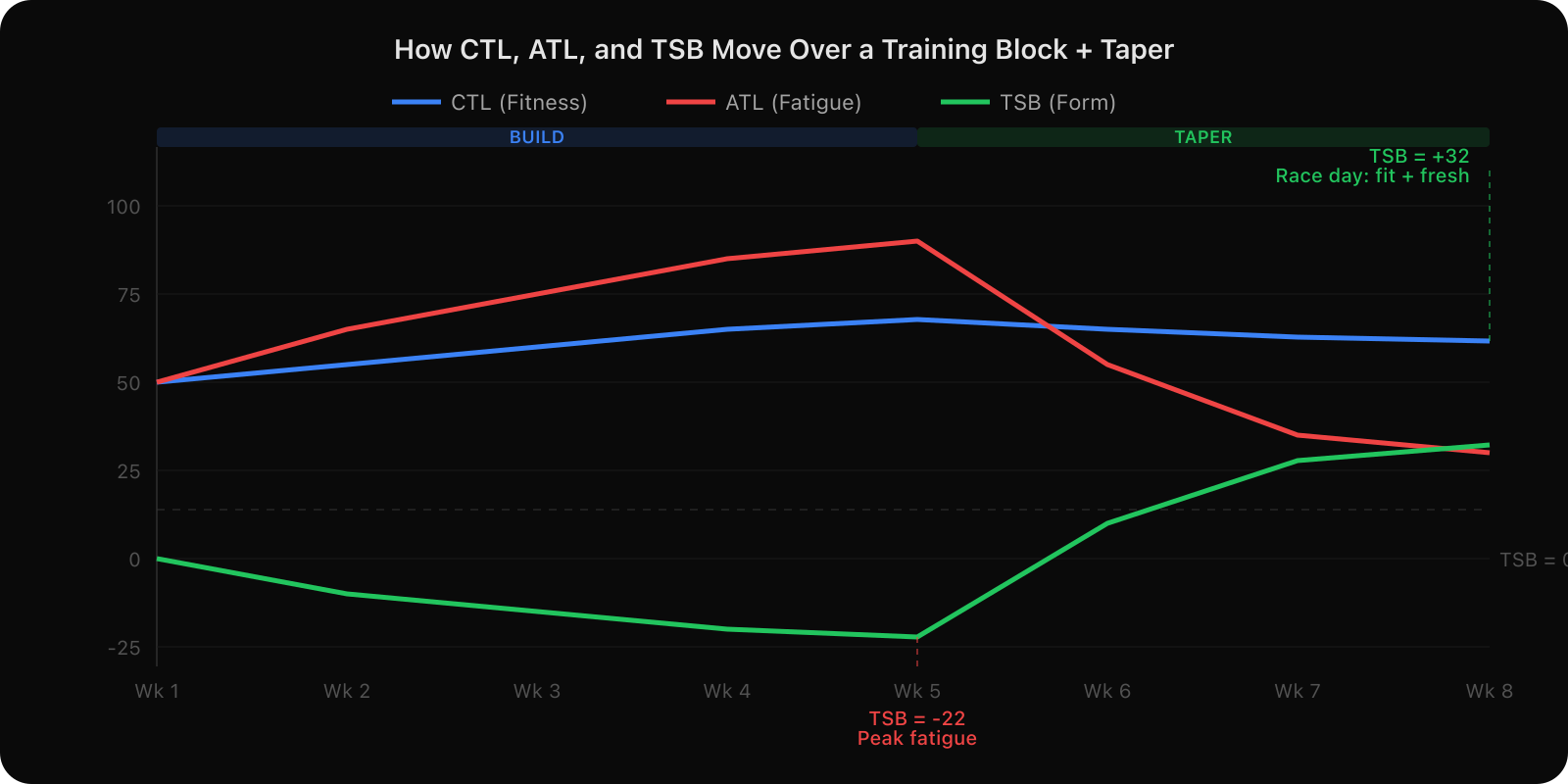
How these numbers move in practice
Here is a concrete example. Say your CTL is 65 and you have been training consistently. Your ATL is also around 65, so your TSB is hovering near zero. You are fit but not particularly fresh.
Now you take a full week off. Your ATL drops fast, maybe down to 25. But your CTL barely budges, maybe it falls to 60. Your TSB shoots up to +35. You feel amazing. That is the taper effect: you kept most of your fitness but shed the fatigue.
Flip it around. You do a massive training block: three big days in a row. Your ATL jumps to 95 while your CTL is still 65. Your TSB drops to -30. You feel wrecked. That is overreaching, and it is fine in small doses, but dangerous if you stay there.
Using TSB to time your best performances
Most athletes race best with a TSB between +10 and +25. Too low and you are too tired to perform. Too high and you have lost some of the sharpness that comes from consistent training.
This is why tapering works. You reduce volume for 7-14 days before a goal event. ATL drops, CTL holds relatively steady, and TSB rises into that sweet spot. You show up to race day feeling both fit and fresh.
The key insight: you cannot just rest your way to a good TSB. If your CTL is 40, a TSB of +15 still means you are not very fit. The magic is having a high CTL and then strategically shedding fatigue.
Common mistakes
Chasing CTL like a high score. Athletes get obsessed with pushing their CTL number higher and higher. But CTL should rise gradually, around 3-5 points per week at most. Ramping faster than that is a recipe for burnout, illness, or injury. A steady upward trend beats a spike every time.
Living in deep negative TSB. Some athletes wear a TSB of -30 like a badge of honor. Spending a week or two in negative territory during a build block is normal. Spending a month there is how you end up overtrained. If your TSB has been below -20 for more than two weeks, you need to back off.
Not tapering enough. I get it. It feels wrong to train less before a big event. But the data is clear: most age-group athletes do not taper enough. They are afraid of losing fitness, so they show up to race day with a TSB of -5 when they should be at +15. Trust the math. Your CTL will not collapse in 10 days.
Ignoring the context. These numbers do not exist in isolation. A TSB of +10 means something different for someone with a CTL of 90 versus someone at CTL 40. And external stress, sleep quality, and nutrition all affect how a given TSB actually feels. The numbers are a guide, not gospel.
Practical guidelines
- Build phase: TSB between -10 and -25. You are accumulating fatigue intentionally. Keep it here for 2-3 weeks, then recover.
- Recovery week: Let TSB rise back to 0 or slightly positive. Reduce volume by 40-50% for a week.
- Race week: Taper to reach TSB of +10 to +25 by race day. Reduce volume but keep some intensity to stay sharp.
- Off-season: TSB near 0 or slightly positive. Lower CTL is fine. Enjoy the break.
How IntervalCoach uses these metrics
This is exactly the kind of decision-making I built into IntervalCoach. Every day, before generating your workout, the system checks your CTL, ATL, and TSB alongside your recovery data. If your TSB is deeply negative and your HRV is suppressed, it will prescribe an easy spin or a rest day instead of the intervals that were originally planned. If you are fresh and your fitness is trending up, it will push you harder.
Your weekly training plan is built around your current CTL. The system sets a weekly TSS target based on where your fitness is now and where it needs to go, then distributes that load across your available training days. During a recovery week, it drops that target by 40-50% automatically.
After every workout, the system recalculates your CTL, ATL, and TSB and shows you how that session moved the needle. You can see exactly how a hard threshold session pushed your ATL up and your TSB down, or how a rest day let your fatigue drop while your fitness held steady.
The training signals system monitors your ACWR (Acute:Chronic Workload Ratio) to catch dangerous load spikes, tracks training monotony to make sure you are not doing the same thing every day, and watches your load-recovery ratio for signs of overreaching. If you have a goal event on your calendar, it will plan your taper automatically so you arrive on race day with your TSB in that +10 to +25 sweet spot.
You do not need to stare at your fitness charts and make these calls yourself. But understanding what CTL, ATL, and TSB mean will make you a smarter athlete, whether you use software to manage them or not.
The bottom line
CTL, ATL, and TSB are not magic. They are a simplified model of how your body responds to training stress. But simple does not mean useless. These three numbers can tell you when to push, when to back off, and when to peak. Learn to read them, and you will make fewer of the mistakes that hold most self-coached athletes back.
Want to look up other training terms? Check the glossary for definitions of ACWR, FTP, CSS, and more.
Frequently asked questions
What is CTL in cycling and running training?
CTL (Chronic Training Load) is your fitness — a 42-day rolling average of your daily training stress. A recreational cyclist typically sits at CTL 40–50, a competitive amateur at 70–90, and pros often above 120. The longer you train consistently, the higher your CTL climbs.
How is TSB calculated and what does it mean?
TSB (Training Stress Balance) equals CTL minus ATL — your fitness minus your fatigue. Positive TSB means you are fresher than your fitness suggests; negative means you are carrying fatigue. It is the single most useful number for deciding when to push hard and when to back off.
What TSB range is best for racing?
Most athletes race best with a TSB between +10 and +25. Below that and you are too tired to perform. Above +25 and you may have lost the sharpness consistent training provides. A high CTL combined with a +10 to +25 TSB is the goal of any successful taper.
How fast should CTL increase per week?
Aim to raise CTL by 3–5 points per week at most. Faster ramps invite burnout, illness, or injury. A steady upward trend always beats a spike. Sustainable training is about consistency over time, not chasing a high CTL number as a high score.
How long should I taper before a race?
A taper typically runs 7–14 days. Reduce volume but keep some intensity so you stay sharp. Most age-group athletes do not taper enough — they show up at TSB −5 when they should be at +10 to +25. Trust the math; CTL will not collapse in 10 days.