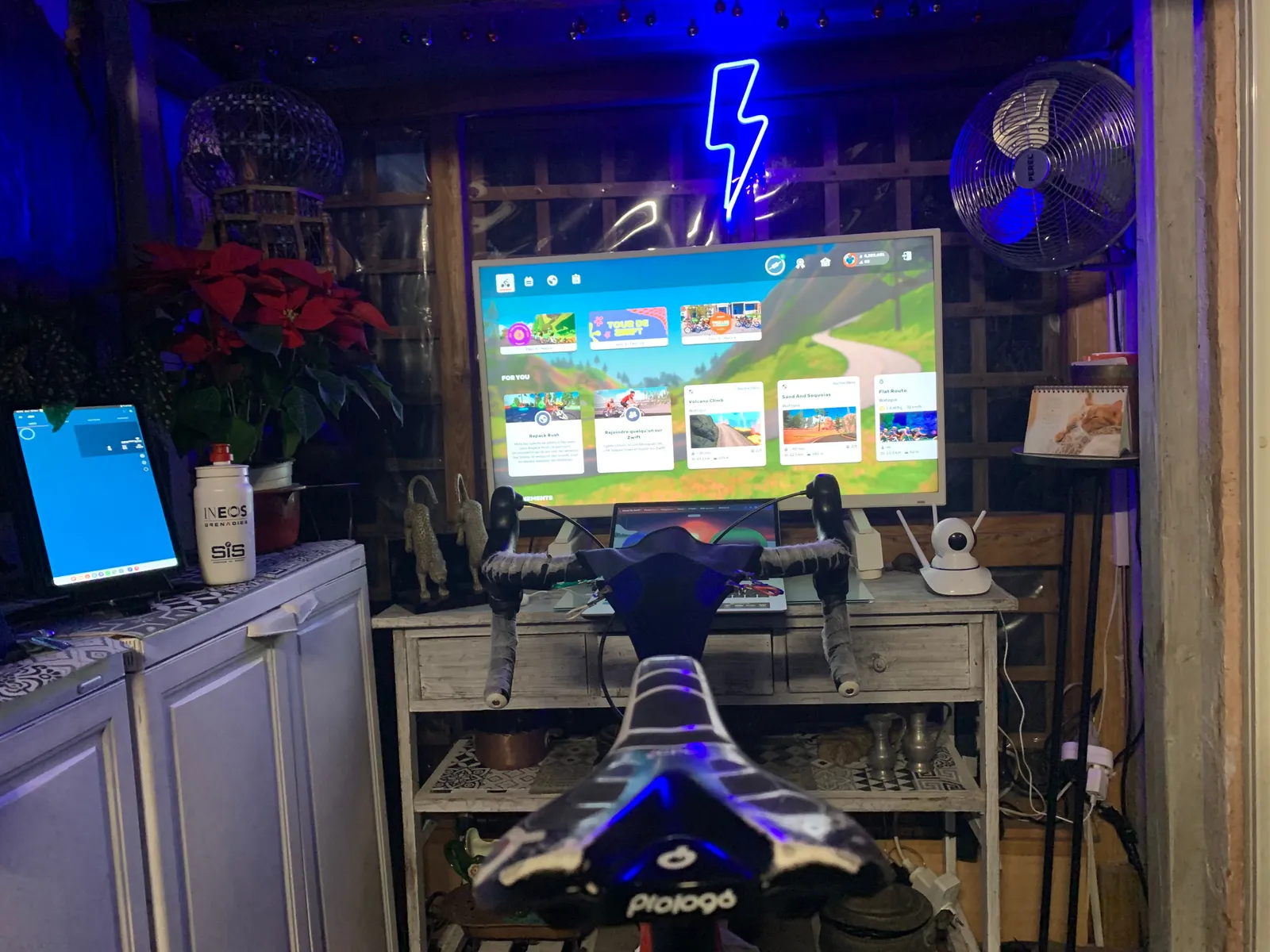
On a Saturday in mid-November, Alain lined up for Stage 2 of the Bikes Five Tour on Zwift, an individual time trial of a little over 14 kilometres. He rode it in 22 minutes at 221 watts average, 230 normalised. Inside that ride sat the best 20 minutes of his season: 228 watts, twelve more than his previous best.
Seven weeks earlier, his training had almost stopped.
The weeks that went quiet
From the middle of September to the start of October, three weeks of his plan went mostly unridden: three sessions out of twelve. His fitness (CTL) slid from 33 in late August to 25 by the end of September. He was simply on holiday abroad. Everyone who trains for long enough has a stretch like this.
What matters is what happens next, because that is where most comebacks go wrong. One version tries to make up the missed weeks in one heroic week and pays for it. The other drifts, one skipped Tuesday at a time. Alain did neither.
A goal, and then the calendar
In the second week of October he set himself a goal: FTP Improvement, eight weeks, ending on 3 December. From that week on, the pattern is almost boring. Tuesday, Wednesday and Thursday, a session on the trainer. Saturday, a Zwift race, which he much prefers to a social ride for the chance to push past his own limits. Sunday, a longer endurance ride. Since the second week of October, nearly every session on his plan has a ride next to it: in most weeks three or four out of four.
The sessions carry French names, "Seuil en côtes", "Seuil Intermittent", "Intervalles VO2max", because IntervalCoach coaches him in French. He rides them on Zwift, alongside his own Zwift rides and races, and the plan has adapted to that rather than fighting it: his Saturdays now carry a slot simply called "Course Zwift", about an hour and twenty minutes, because that is what he does on Saturdays.
What the comeback bought
The time trial is the headline, but the easier rides tell the same story more quietly. In mid-November he rode 42 steady minutes at 145 watts normalised. Five weeks earlier, a comparable endurance ride had come in at 132, with his heart rate within three beats of today's. Thirteen watts more at almost the same heart rate is not a peak. It is a rider whose base is coming back underneath him.
His CTL has climbed from 25 at the end of September to 37 by mid-November, back above where it stood before the quiet weeks. His estimated FTP sits at 221 W.
What the score noticed
| Week | Total | Consistency |
|---|---|---|
| Sep 25 | 42 | 33 |
| Oct 9 | 55 | 0 |
| Oct 30 | 56 | 58 |
| Nov 13 | 63 | 70 |
The 0 in October is the score still looking back over the empty weeks while he had already restarted; the same snapshot read his return as a jump in load. As the gap rolled out of the window, Consistency reached 78 in early November and held at 70 the week after. Fitness Base, the slowest number in the score, moved from 46 to 53 behind it.
The number still to come
One result is still open. A ramp test on his plan in mid-November was not ridden to the end, so his FTP has not yet been tested in this block. He has said he will ride an FTP test if IntervalCoach puts one on his plan. The time trial suggests what it will say.
My prediction: the next ramp test he finishes confirms an FTP of at least 221 W, the number his estimate already shows. That is the result I will be looking for.
You can follow Alain at intervalcoach.app/p/h-alain, and see your own version of this on your Analytics page: your best 20 minutes, your CTL, the shape of your own comeback. And if you would like to be featured in a future spotlight, reply to any IntervalCoach email and say so. The riders in this series are real, the numbers are theirs, and the work is the point.